

Tariffs and costs will feature prominently, with industry stressing that project viability depends on timely PPAs, transmission readiness, and fair bidding structures.
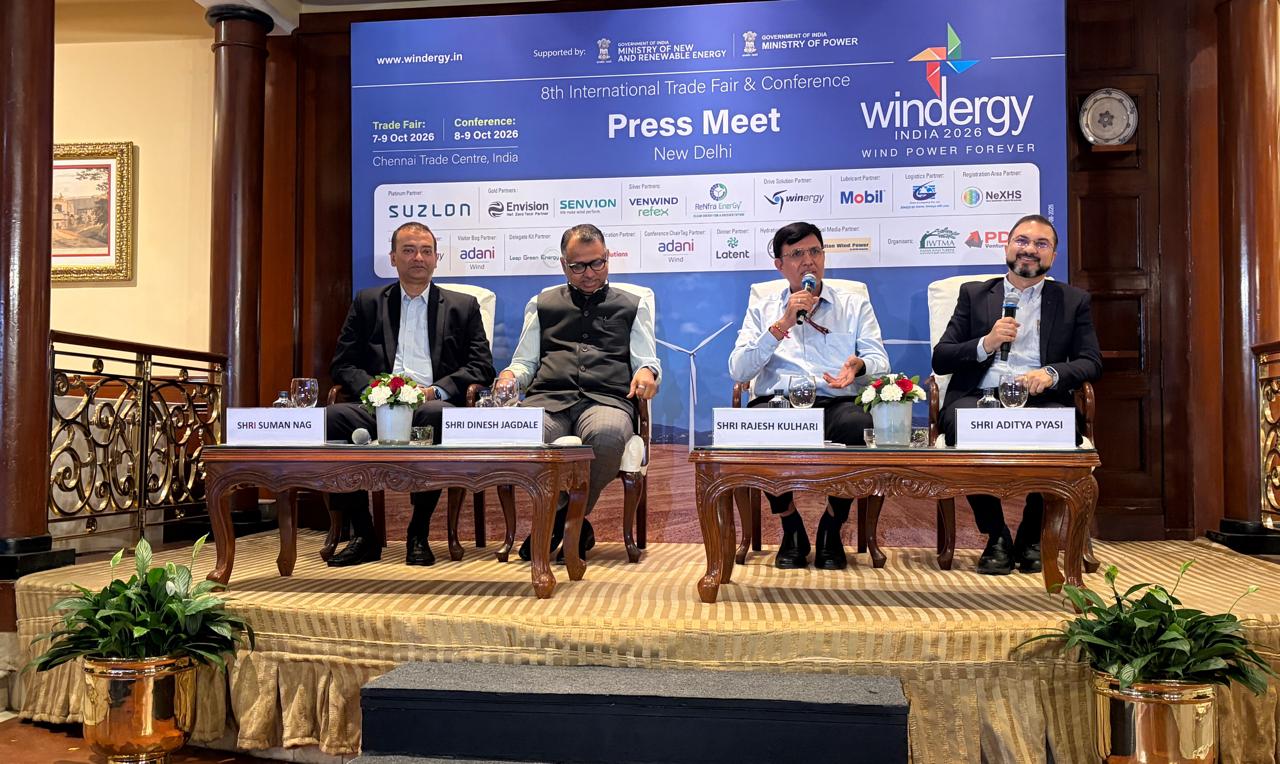
India’s wind energy sector will once again take centre stage at Windergy India 2026, the 8th edition of the country’s flagship wind platform, from October 7-9, 2026, at the Chennai Trade Centre.
Speaking at the curtain‑raiser in New Delhi, Rajesh Kulhari, Joint Secretary, Ministry of New and Renewable Energy (MNRE), said, “India’s energy transition is no longer just about adding megawatts. It is about building a complete industrial ecosystem; one that creates skilled jobs, drives wind manufacturing exports, guarantees energy security, and lowers system costs by reducing dependence on fossil fuels.”
India added 6.05 GW of wind capacity in FY2025‑26, its best year on record, taking cumulative installed capacity to 58.14 GW as of July 31. The industry is now targeting 100 GW by 2030, requiring sustained annual additions of around 10 GW. A live pipeline of roughly 43 GW is under construction, with assessed potential of up to 1,164 GW at 150‑metre hub heights, according to the industry body, the Indian Wind Turbine Manufacturers Association (IWTMA).
Dinesh Jagdale, Honorary Secretary, IWTMA, and President of Corporate Affairs & Retail Business, Suzlon Energy Ltd, said, “India’s wind sector has already proven it can scale from a nascent industry to over 58 GW of installed capacity, with a manufacturing base now exporting turbines worldwide. The path ahead is clear: 100 GW by 2030, 155 GW by 2035. Getting there needs collaboration between manufacturers, developers, policymakers, and innovators working together.”
Manufacturing and Exports
Domestic turbine‑making capacity has grown to 24 GW annually, up from 10 GW in 2014, with 70-80 per cent domestic value addition. Wind equipment exports crossed ₹120 billion in FY2025‑26, up nearly 50 per cent. MNRE has launched WT‑MARUT, India’s first wind supply‑chain portal, positioning the country as both a rapid‑deployment market and a global export hub.
Suman Nag, Global Business Development, Envision Energy India Pvt Ltd, and Executive Committee Member, IWTMA, said, “This reflects a sector coming of age. As export‑oriented companies continue to scale manufacturing and expand exports from India, we remain committed to strengthening the country’s position as a global wind export hub and to contributing meaningfully to India’s broader export ambition.”
Tariffs and energy cost will feature prominently, with industry voices stressing that viability now hinges less on chasing the lowest tariff and more on timely Power Purchase Agreements (PPAs), transmission readiness, and bidding structures that recognise the added system value of wind, hybrid, and firm renewable power.
Logistics efficiency is critical for reliable operations and timely movement of turbine components, requiring route planning, permitting, heavy‑lift solutions, warehousing, and spares logistics. Digitalisation and tracking are improving visibility and efficiency across the supply chain.
Repowering Opportunity
Repowering India’s ageing fleet of 19,000‑plus sub‑MW wind turbine generators (WTGs) in high‑wind zones could nearly double performance. Legacy WTGs operating at 14-15 per cent capacity utilisation factor (CUF) can be upgraded to around 30 per cent CUF through modern technologies.
Pradeep Devaiah, Chairman & CEO, PDA Ventures Pvt Ltd, said, “Windergy India, international trade fair and conference, has grown into a platform that brings the entire wind ecosystem together. As India works towards its capacity targets, we will keep doing our part to give this industry the platform it needs to connect and grow.”
Organised by IWTMA and PDA Ventures Pvt Ltd, supported by the Ministry of Power and MNRE, Windergy India 2026 is expected to attract over 20,000 attendees, 400 delegates, and 350 exhibitors from more than 30 countries.