

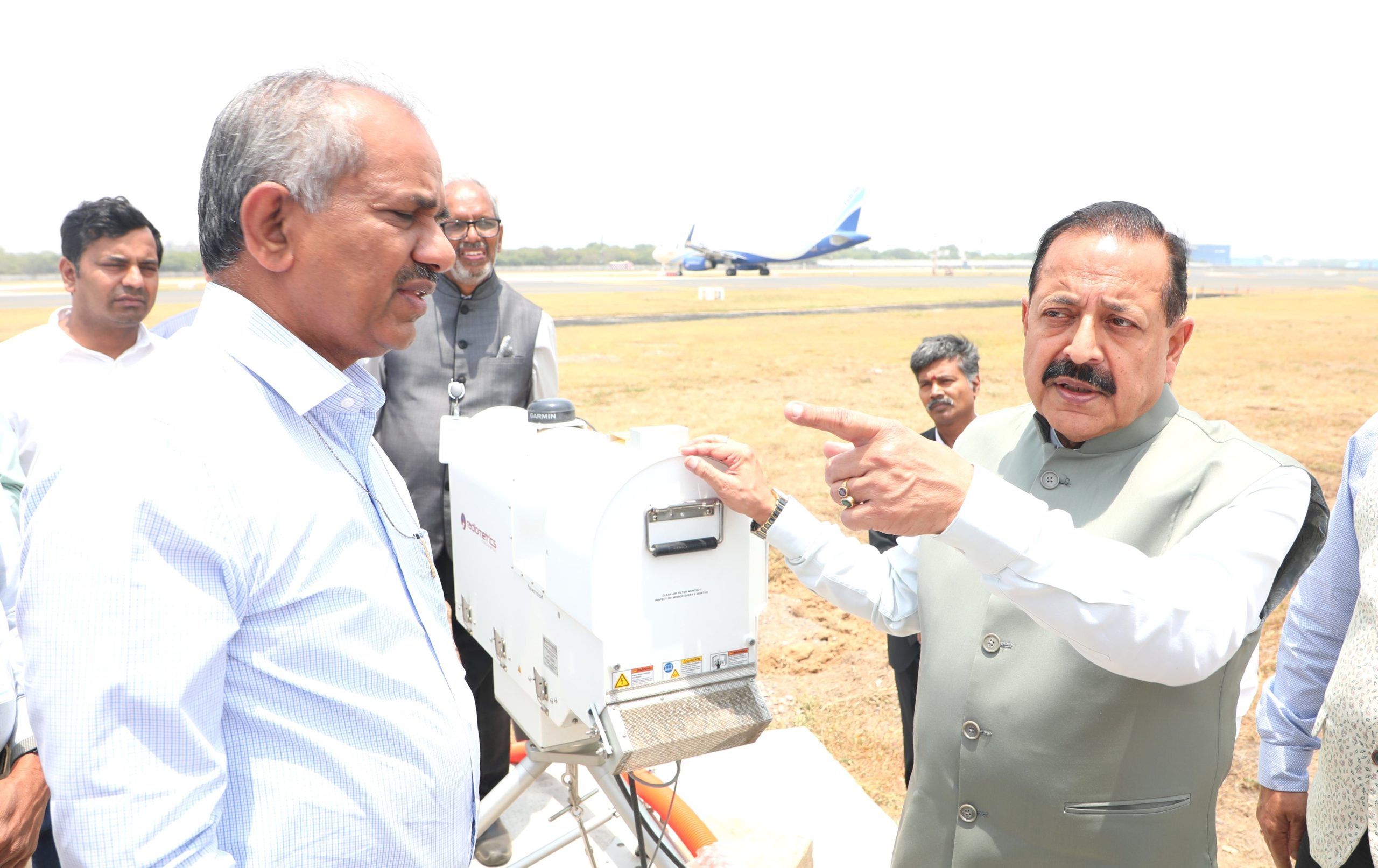
After the launch, Union Minister Jitendra Singh said similar weather stations will be installed at Jewar, Varanasi, Ahmedabad, and other airports.
In a major fillip to aviation safety, Delhi’s Indira Gandhi International Airport has become the first airport in the country to deploy its own next‑generation weather station. The advanced, integrated aviation weather intelligence and nowcasting facility called SKYCAST was inaugurated at India’s busiest airport in partnership between the Ministry of Science & Technology and Delhi International Airport Ltd (DIAL) on Friday.
As a next‑generation aviation meteorological platform, SKYCAST integrates advanced remote sensing technologies, atmospheric profiling systems, and intelligent nowcasting tools to continuously track rapidly evolving weather conditions that may impact flight operations. The system combines a Radar Wind Profiler (RWP), Microwave Profiling Radiometer (MPR), Sonic Detection and Ranging (SODAR), and Automated Weather Stations (AWS) to deliver high‑resolution wind and thermodynamic profiling of the atmosphere.
Following the inauguration, Jitendra Singh, Union Minister of State (Independent Charge) for Science & Technology and Earth Sciences, noted on the microblogging site X, “This is a state‑of‑the‑art integrated atmosphere remote sensing equipment for fog monitoring, high‑resolution continuous monitoring of turbulence, wind speed, vertical velocity, aerosols etc.”
The facility enables continuous, real‑time monitoring of critical atmospheric parameters, including temperature and humidity profiles, water vapour density, cloud liquid water content, wind speed and direction, vertical wind structures, and near‑surface high‑resolution wind observations. Singh added that similar weather stations will be installed at Jewar, Varanasi, Ahmedabad, and other airports.
Globally, comparable advanced atmospheric profiling and aviation weather intelligence systems are deployed at leading airports such as Hong Kong International, Heathrow, JFK, and Singapore Changi, as well as at NASA and Cape Canaveral launch facilities.
Precision Weather Monitoring
The facility can assess atmospheric conditions from the surface up to nearly 10 km altitude for thermodynamic profiling and several kilometres for wind observations. This significantly enhances the ability of meteorologists and aviation stakeholders to track and respond to rapidly changing weather systems.
Using advanced algorithms and integrated atmospheric analysis, SKYCAST generates a wide range of derived aviation meteorological parameters such as wind shear magnitude and depth, headwind, tailwind and crosswind components, low‑level jet characteristics, atmospheric stability indicators, temperature inversion analysis, fog formation indicators, boundary layer dynamics, icing potential, and storm and precipitation characteristics.
Videh Kumar Jaipuriar, CEO‑DIAL, said, “SKYCAST is an important step forward in making Delhi Airport even safer and more resilient for everyone who travels through it. Weather can change very quickly, and having access to accurate, real‑time information makes a real difference on the ground and in the air.”
The deployment of SKYCAST is expected to significantly strengthen aviation safety during take‑off and landing, runway and air traffic flow management, operational preparedness during fog and severe weather, reduction in weather‑related delays and diversions, real‑time pilot situational awareness, passenger convenience, and operational predictability.
A key feature of SKYCAST is its automated nowcasting and hazard alerting capability. The system detects and provides real‑time alerts for critical aviation hazards, including wind shear, fog, inversions, low‑level jets, icing, and turbulence. It also supports outputs for the Integrated Wind Shear Alerting System (IWAS), convective initiation forecasts, fog evolution trends, and short‑term operational nowcasts updated every five minutes.
The platform is supported by the VizAir software suite, which offers a comprehensive decision‑support interface with advanced visualisation and analytics tools. It provides operational weather intelligence to meteorologists, air traffic controllers, and pilots. The system is aligned with the International Civil Aviation Organization (ICAO) and the US Federal Aviation Administration (FAA) standards and enables runway‑specific wind shear alerting tailored to operational requirements.