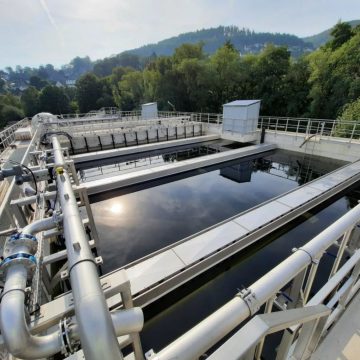
The contract spans design to commissioning of a state‑of‑the‑art effluent treatment plant at RIL’s Jamnagar complex. VA TECH WABAG, a leading pure‑play multinational water management company, has secured a medium‑sized order for an effluent treatment plant (ETP) in the ₹1-2.5 billion range from Reliance Industries Ltd (RIL). The contract covers the design, engineering, manufacturing, supply, erection...


Tag: wastewater
Post
Post
BIG Data The New Oil
The ability to harness and store large volumes of data to enable future services and add extensions to current services to improve can only be achieved with big data.
Post

Curb that wastage!
Less than 20 per cent of the wastewater discharged by households, and 60 per cent of industrial wastewater, is treated in India. This situation has to change, say SHISHAM PRIYADARSHINI and AMISH SHROFF.
Post

Water Relief!
India is urbanising at, what a Union Minister has termed, a very 'dramatic' clip. It today has 50 cities with a population of over one million. As per the 2011 Census, the total number of cities and towns in the country had increased to 7,936 from 5,161 in 2001.
Post

Around 15percent of waste is being segregated at various levels
The Municipal Corporation of Greater Mumbai (MCGM) receives approx 9,000 tonnes of municipal waste on a daily basis at three locations, namely Deonar, Mulund and Kanjur. Approximately 3,000 tonnes of Municipal Solid Waste (MSW) are being processed using Bio-Reactor Technology at the Kanjur processing and landfill site.
Post

The Smart Cities programme is brimming with potential for smart water solutions
Urban settlements´ access to a reliable water supply is improving, as is the quality of the water supplied. However, there is still a great deal more to do. The World Bank estimates that 21 per cent of communicable diseases in India are related to unsafe water.
Post
Scaling the urban ladder
Rapid urbanisation has brought in a sling of progressive measures from the policy-makers. A transition has to set in to accommodate such exponential growth in the urban population.
Post
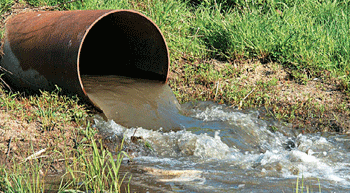
Decentralised Wastewater Management Systems
Urban India is bracing for a unique and difficult challenge of shortage of freshwater as well as managing increased wastewater. Urban India is experiencing an exponential growth. With about 377 million people
Post

Exploring water opportunities from a clean Ganga
Clean Ganga Mission under good governance is an essential drive as a mission, at the heart of translating zero tolerance to any contamination of the holy river Ganga, which shall also be a model for all the rivers and water bodies.
Post
Towards a greener India
Increasing regulatory pressures, aging infrastructure, and environmental concern are forcing organisations to reassess the impact of water management on their economic wellbeing.
- 1
- 2