A Guarantee Agreement for World Bank (IBRD) lending of $650 million to the Dedicated Freight Corridor Corporation of India Ltd (DFCCIL) for the Eastern Dedicated Freight Corridor-III (EDFC-III) Project has been signed between the Government of India and the World Bank in the national capital.


Tag: World Bank
Post

Post
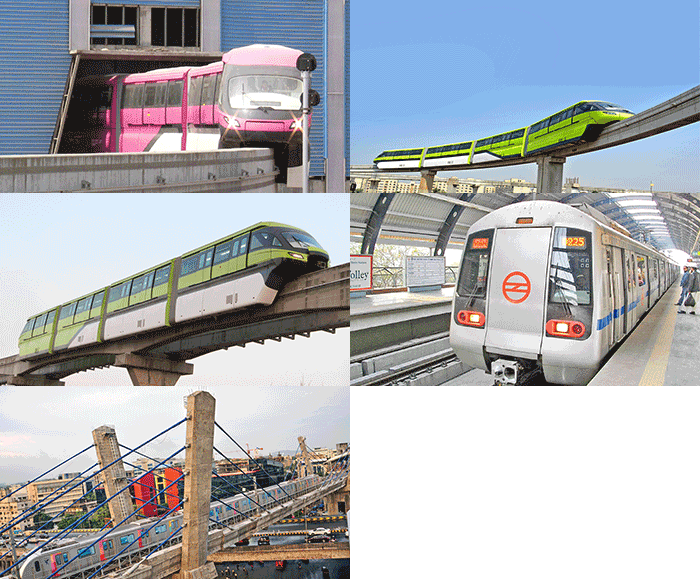
State of the Smart
Urban planners are developing seamlessly integrated transportation services, while also according ease of travel options for commuters without the routine hassles of congestion, delays and lack of intermodal connectivity.
Post
UPSIDC plans to raise Rs.1,500 cr
Faced with creaking infrastructure in its industrial enclaves across the state, Uttar Pradesh State Industrial Development Corporation (UPSIDC) is mulling to raise funds from external agencies, including the World Bank.
Post
India´s Ease of Electricity rank jumped 29 points
India ranks 70 among 189 economies on ease of getting electricity due to positive reforms that have aided ease of doing business in the country, according to a latest report by The World Bank. India has jumped by a whopping 29 points from 99 last year, the report said.
Post
Monitoring contractual obligations is the next big thing for India
Indeed. From the mid-1990s, where we started with private sector involvement with power generation, and subsequently into mobile telephony and transport sector in the mid-2010s, we are easily the world´s largest PPP market. India has travelled a long way.
Post

METRONOMICS
The experience left the planners wiser. And this was evident in the 65 kilometres of the first phase of the ambitious Delhi Metro Project getting completed a full two years nine months ahead of schedule in 2005, in a period of a little over eight years.
Post
Jharkhand 10th highest receiver of FDI
Proving itself as a major emerging investment destination, Jharkhand has been ranked as the 10th highest receiver of Foreign Direct Investment proposals in the year 2015, in a ranking of top FDI earning states in India and China.
Post
India´s Achilles heel is lack of spectrum
It is not unusual among developing countries, to find that Internet usage lags behind mobile take-up. India suffers in the sense that, as a huge country with significant usage of local languages, it relies primarily on terrestrial networks for delivery of service, which tend to be more expensive to provide than submarine networks.
Post

En route to MAHA growth
By signing Memorandums of Understanding (MoUs) worth Rs.8 lakh crore, Maharashtra managed to outpace other states in the recently held Make in India week. The MoUs being signed by various companies, and with these firms indicating their investment intentions, clearly showcases the faith being reposed in Maharashtra by the industry.
Post
Where are the investor-friendly policies?
First and foremost, water is a scarce commodity. If at all there is a war, it will be for water, now. Unfortunately, in India, the per capita availability of water has decreased in the past decade (if I go by the official record) from 1860 cubic metres in 2001 to 1545 cubic metres now.