

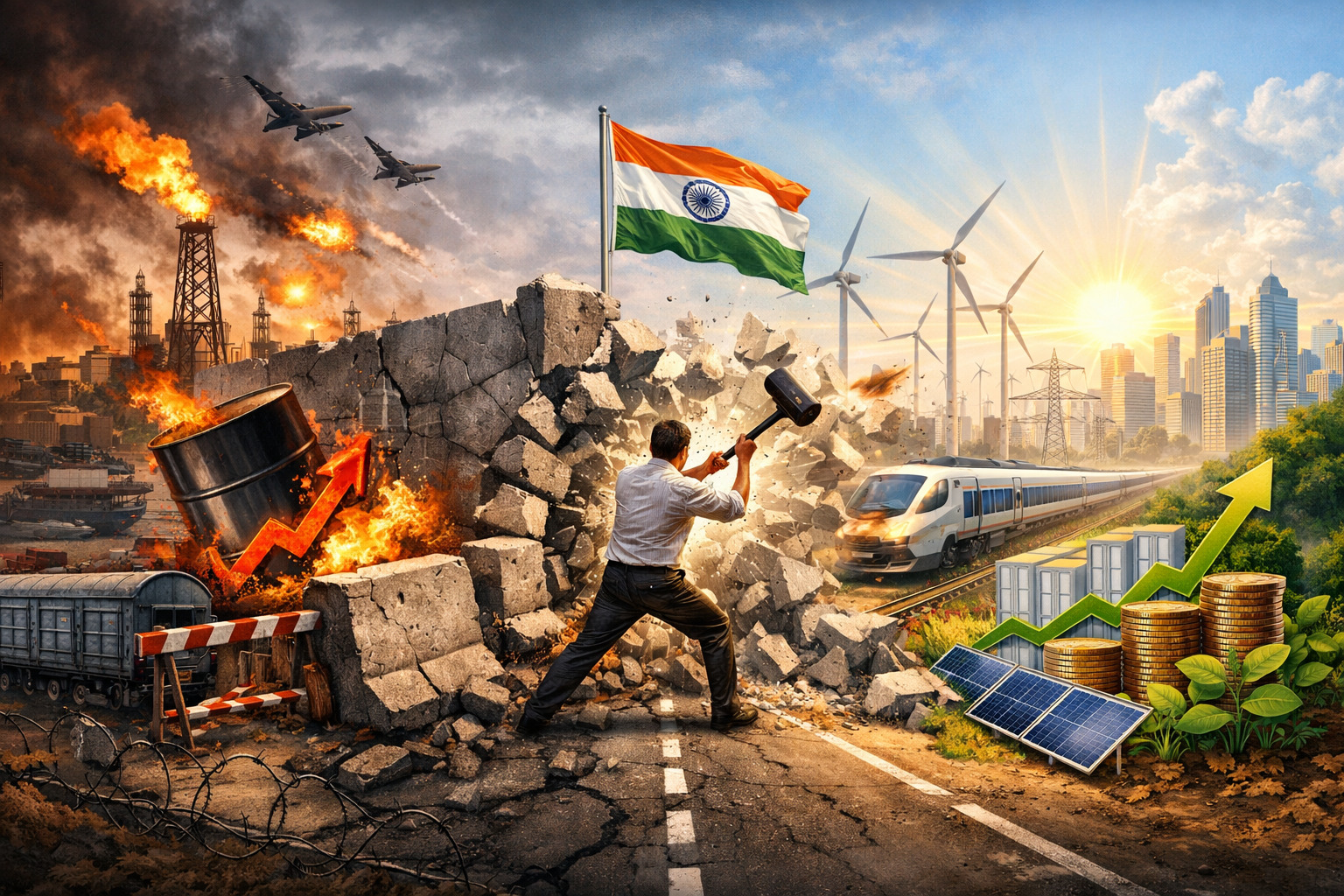
A report by the global consultancy says the energy shock could be an opportunity to tackle tactical issues and clear roadblocks, helping the world’s fastest‑growing major economy achieve longer‑term growth and sustainability goals.
The energy price surge and supply constraints triggered by the conflict in West Asia are feeding into broader economic stress for India, with GDP growth in the world’s fastest‑growing major economy expected to moderate in FY2026‑27, according to a new report by the India Research Chapter (IRC) of consultancy S&P.
Released on Wednesday, India Forward: Strategic Imperatives highlights that the conflict represents the biggest test of India’s resilience in recent years, with the largest energy shock on record spilling into freight and insurance costs, supply chains, and fertilisers. These challenges have spotlighted energy and food security reforms linked to India’s Viksit Bharat (Developed India) 2047 goals.
“The growth outlook for fiscal year 2027 now stands at 6.6 per cent. This is below our earlier forecast of 7.1 per cent and 7.6 per cent in fiscal year 2026, driven by the continuation of the Middle East war, as well as the destruction of energy infrastructure and consequent gas supply shortages, slowing industrial production. Brent crude oil is forecast to average $96/barrel this fiscal year and about $90/barrel in fiscal year 2027,” the report notes.
While healthy private consumption and steady investment should support growth, and exports will be aided by lower US tariffs, disruptions in shipments to the Middle East, rising freight costs, and weakening global demand will keep export growth subdued.
The sustained nature of the conflict is shifting India’s risk management focus from immediate buffers to medium‑ and long‑term strategies. India’s post‑COVID fiscal consolidation—reducing the fiscal deficit from 9.2 per cent of GDP in FY2021 to 4.4 per cent in FY2025‑26—now faces its toughest challenge.
Clearing Roadblocks
The report suggests the shock could be an opportunity to address tactical issues and remove roadblocks to help achieve longer‑term growth and sustainability goals. The current energy crisis reinforces the need for a reliable and resilient energy system, supported by a robust energy storage framework. Policymakers and regulators can accelerate reforms, though the pace of change will remain tied to India’s dependence on global energy flows and supply chains.
“India’s energy demand is forecast to double in the next 25 years, offering an opportunity to build cleaner, more efficient [energy] infrastructure. This can further improve energy security and affordability by reducing dependence on imports. However, geopolitics and energy will remain closely linked,” the report adds.
The report has been compiled by S&P Global and its India subsidiary, Crisil’s cross‑divisional India Research Chapter, a thought leadership initiative of the S&P Global India Leadership Council.