

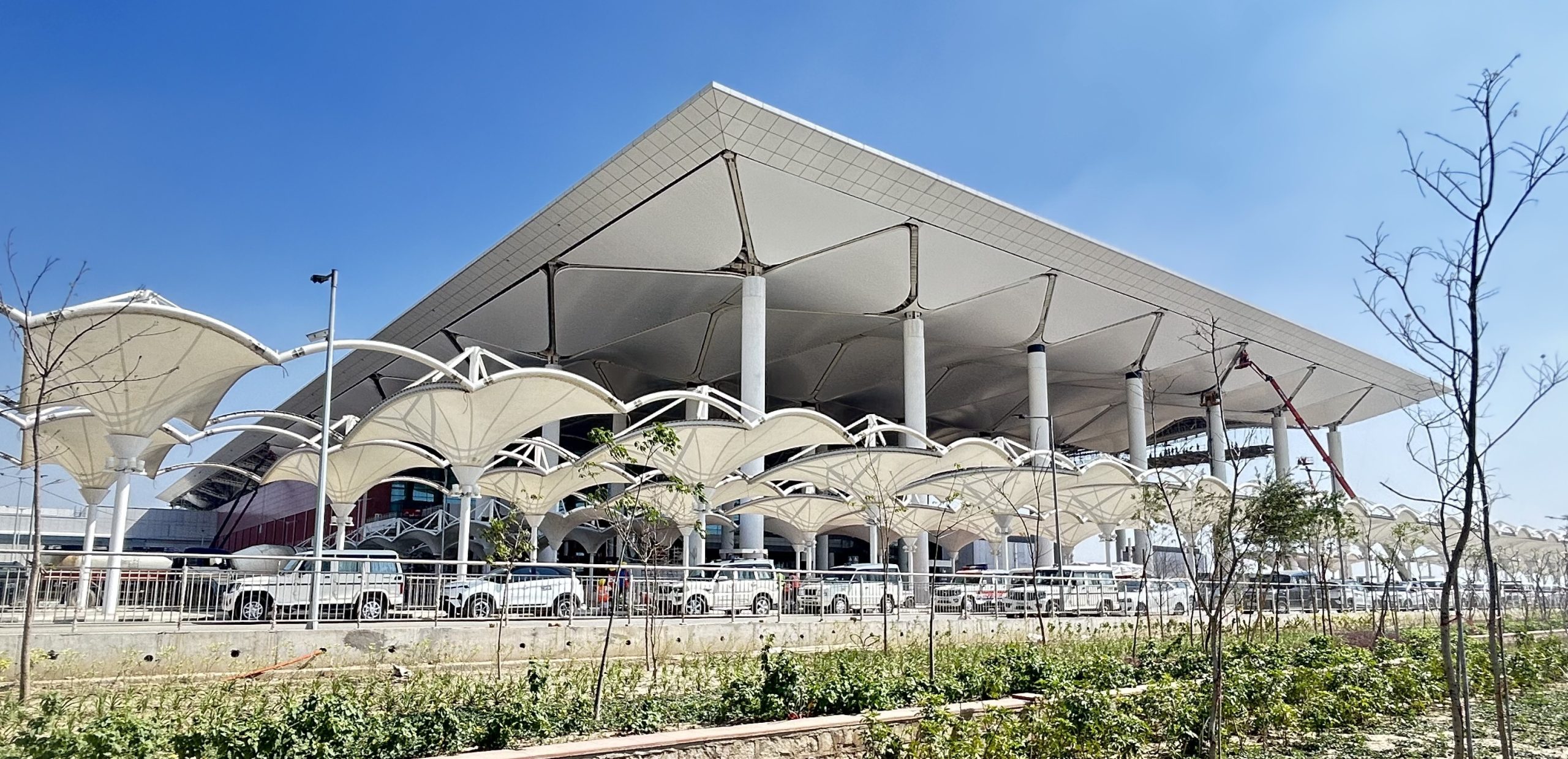
Great infrastructure creates memorable human experiences on an ambitious scale, and Noida International Airport—set to be operationalised on June 15—reveals this truth through three interconnected lenses of the ‘place-process-people’ framework, writes Smitha Ranganathan.
The first impression of a country is rarely formed in a monument, a marketplace, or a meeting room. It is often formed at an airport. For many travellers arriving in the Delhi National Capital Region, Noida International Airport (NIA) will be their first real encounter with India. For several others, it may be the last image they carry home. That makes it far more than a piece of infrastructure. It becomes India’s visiting card, a small but powerful signal of who we are becoming.
The question, then, is not only how efficiently the airport will move people, but what it will make them feel about India. Like any visiting card worth carrying, it invites a question we must answer carefully: ‘What do we want it to say about us?’
Great infrastructure creates memorable human experiences on a large scale. NIA reveals this truth through three interconnected lenses, which I choose to call the ‘place-process-people’ framework.
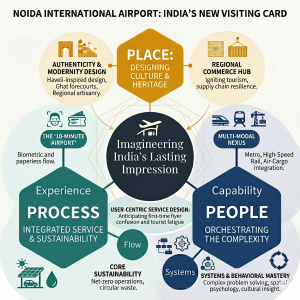
Place: Cultural Design
Picture this: 10,000 workers at peak construction, 70 million passengers annually—nearly France’s population—passing through each year on commencement of operations. Engineers battle seismic risks and difficult terrain. This is India’s new infrastructure rhythm, from airports to smart cities.
But NIA dares to do more. In a world of identical glass-and-steel terminals, it whispers India’s story through haveli-inspired courtyards, forecourts echoing Varanasi’s ghats, and retail celebrating Banarasi silks and Chikankari designs. These aren’t decorative flourishes but strategic artefacts of economic signals of a single space carrying culture, igniting tourism, strengthening supply chains, signalling regional confidence.
Imagine a weary traveller newly arrived from Dubai, stepping into a forecourt that feels like home yet thrills like discovery. That moment of recognition, that quiet pride, that’s what great place design delivers. This demands professionally weaving together architecture, culture, tourism, branding, commerce, regional economics and green materials science. No longer one discipline’s work, but many minds learning to think as one.
Process: Seamless Systems
Airports were once designed to move passengers and baggage from the kerb to the gate. But today’s traveller arrives carrying more than luggage. The first-time flyer clutches confusion. The tourist balances fatigue and wonder. The family juggles care and coordination. The business traveller guards every minute. Noida’s ‘10-minute airport’ vision, with biometrics dissolving queues, paperless journeys, and baggage finding you, promises technology so seamless it disappears.
This extends to net-zero operations, solar canopies over parking, rainwater harvesting feeding terminals, EV charging woven into the design, and waste sorted before it becomes waste. Thus, sustainability isn’t an add-on, but it’s the operating system.
Physical spaces must breathe with movement. Operations must dance to real-time data. Service design must anticipate hesitation before it forms. Digital systems must earn trust through reliability, not flash. One unclear sign, one design flaw, one brusque interaction ripples through every journey.
Atithi Devo Bhava (the Guest is God) becomes a design principle here. While technology ensures efficiency and design creates beauty, it’s only human orientation that crafts memory. Picture a family with an elderly parent, a passenger with reduced mobility, and an airline crew member rushing to connect their dignity preserved not by policy, but by anticipation.
People: Human Capital
Airports aren’t endpoints anymore. Along the Yamuna Expressway, integrated with metro rail, bus, and future high-speed rail, Noida becomes a multimodal nerve centre and economic engine, with cargo humming, MRO facilities rising, trade corridors activating, and tourism multipliers sparking.
This demands more than terminal operators but orchestrators of complex systems shaping regional futures. Engineering excellence is now a baseline expectation, and the real differentiator is interdisciplinary mastery, systems thinking, digital fluency, service intuition, behavioural insight, sustainability and cultural imagination and circular economy principles.
Higher education institutions must lead this transformation. We must create inclusive, interdisciplinary programs that break disciplinary silos and mirror real-world complexity. We must inspire students not just to build but imagineer, to re-imagine engineering not just calculate loads but understand flows; not just master software but ask better questions about human experience.
Here are three spheres of influence for institutions of higher learning to pave the way to imagineering. Firstly, build interdisciplinary curricula where engineering students learn service design and green building codes, management students study spatial psychology and lifecycle carbon accounting. Secondly, foster inclusive problem-solving that includes diverse learners, regional contexts, accessibility needs, sustainable materials, and cultural nuances.
Thirdly, create experiential learning through live projects with airports, cities, transit authorities and sustainability metrics included from day one. Finally, develop green skills to train leaders in net-zero operations, circular supply chains, and regenerative design as essential as structural engineering.
We need dreamers who see airports as cultural statements, doers who integrate biometrics with hospitality training and solar microgrids, and analysts who refine real-time operations while tracking carbon intensity. Crucially, they must work in alignment.
Every traveller through NIA will carry away India’s impression. Will it whisper efficiency alone, or warmth and care? Precision without presence, or competence with compassion delivered through sustainable systems? Long after runways fade from memory, people remember how the country made them feel. That is infrastructure’s ultimate measure and higher education’s defining challenge.
ABOUT THE AUTHOR:

Smitha Ranganathan, Associate Professor at BITS Pilani WILP, is a digital strategy and management educator focused on building future-ready, compassionate, human-centred capabilities for a changing India.