

At the tipping point of a fundamental shift in urban road safety, Bhushan Kudale highlights the most overlooked contributor: conspicuity.
Every year, around 1.12 million people lose their lives globally in road traffic crashes, with nearly 50 million injured or disabled. International studies confirm a chilling reality: nearly half of all fatal crashes occur at night, despite traffic volumes being significantly lower.
In rapidly developing infrastructure landscapes like India’s, this risk is amplified by uneven street lighting, rural networks, and highways that stretch far beyond the reach of the electrical grid. When the grid ends, the materials must begin. As we stand at the tipping point of a fundamental shift in urban road safety, we must address the most critical yet overlooked contributor to safety: conspicuity.
Visibility vs. Conspicuity
Too often, ‘visibility’ is mistaken for safety. A well-lit road can still be confusing if lane markings are blurred or signage is washed out. Visibility is simply the ability to see; conspicuity is the ability to intuitively recognise and interpret what you see in real-time.
For a road sign to be truly conspicuous, it must return light to the driver’s eye with engineered precision. This is where the concept of the ‘Cone of Reflection’ becomes vital. When a vehicle’s headlights strike a sign, the light bounces back in a cone shape. If that cone is too narrow, the light may miss the driver entirely, especially if they are sitting high up in a truck or SUV.
Geometry of Safety
The modern road is not uniform. It carries low-seated sports cars, family sedans, elevated SUVs, and massive commercial trucks. This variety presents a geometric challenge. A truck driver sits much higher relative to their headlights than a sedan driver does; this is known as a larger ‘observation angle’.
Legacy reflective materials often fail this test. They may reflect brightly to a sedan driver but leave a truck driver in the dark because the ‘cone’ of returned light is too tight.
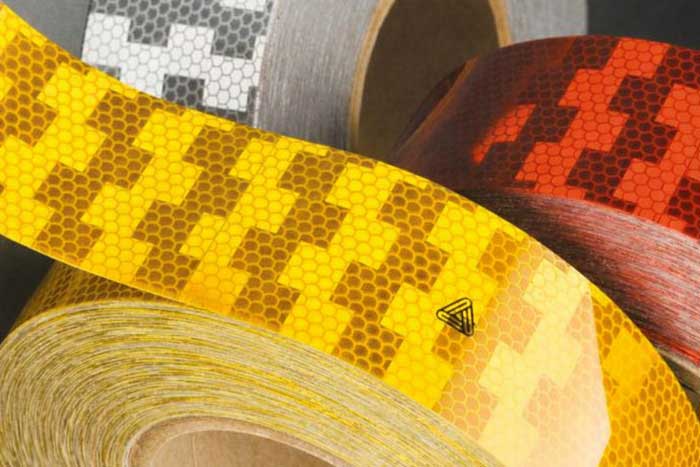
By utilising full cube microprisms, a sheeting has been engineered to create a larger cone of reflection. This ensures that light is returned effectively to drivers at all observation angles. Whether you are in a compact car or a heavy-duty haulier, the sign remains luminous and legible. This technology is a vital step toward making road safety more equitable for all vehicle types, recognising that a 40-tonne truck needs just as much guidance, if not more, as a passenger vehicle.
Efficiency Leap
The difference between adequate and superior safety lies in efficiency. Traditional reflective materials use glass beads or truncated prisms, which are inherently inefficient. The glass bead technology recovers only about 40 per cent of the light striking it. Truncated prism technology improves this to roughly 67 per cent.
Meanwhile, full cube prisms achieve approximately 100 per cent efficiency. By capturing and returning 100 per cent of the available light, full-cube materials act as passive guidance systems that do not rely on power, sensors, or human intervention. They transform headlight beams into clear, unmistakable visual cues, ensuring that vital regulatory and warning signs are visible earlier, reducing driver fatigue and reaction time.
Performance Under Pressure
Road environments are unforgiving. A reflective surface that performs well on day one but degrades shortly after is a liability, not a safety solution. Studies have shown that traditional beaded materials can experience significant degradation, often up to 50 per cent, depending on environmental severity.
This cycle has been successfully broken through advanced engineering. Modern full-cube sheeting is engineered for long-term resilience, with durability ratings of up to 15 years. Advanced encapsulation techniques and improved binders provide enhanced resistance to mechanical wear, ensuring that the road’s visual language remains fluent and consistent for over a decade.
Resilient Road Systems
Invisible engineering decisions have visible, life-saving outcomes. When streetlights go dark, it is not technology that steps in first; it is materials.
Policymakers, engineers, and urban planners must view the road surface not just as asphalt, but as an information system. By adopting high-efficiency, full-cube reflective materials that cater to the geometry of modern vehicles, we embed safety directly into the infrastructure. This does not require a behavioural change or complex technological adoption. Just the simple, scientifically backed decision to use materials that keep our roads conspicuous, night after night.
ABOUT THE AUTHOR:

Bhushan Kudale is Business Head, Reflectives Division, Avery Dennison for South Asia & ASEAN.