

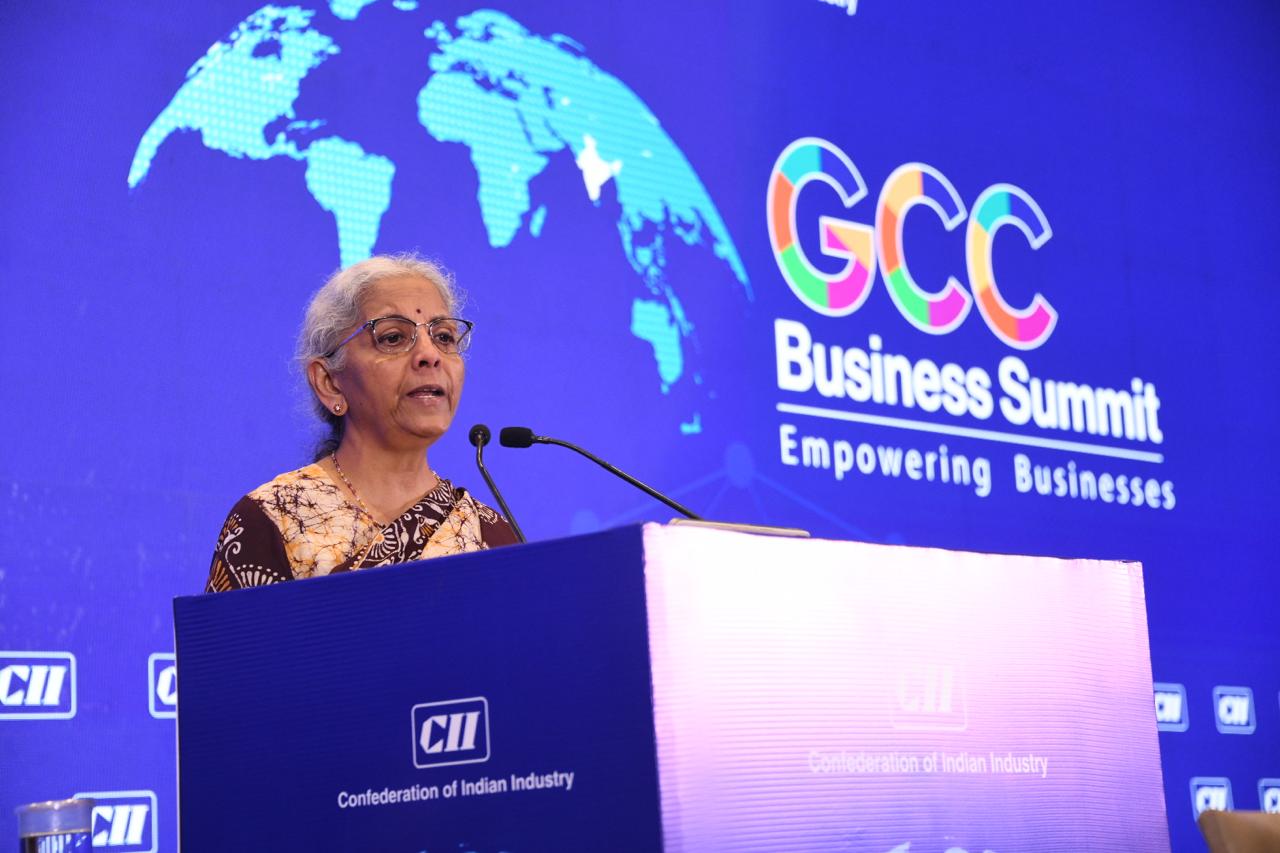
The Union Finance Minister stressed that India must stay ahead of the GCC curve by building a facilitative ecosystem.
The evolution of India’s Global Capability Centre (GCC) sector from cost efficiency to capability leadership reinforces that global enterprises are no longer choosing locations based on cost alone, Union Finance Minister Nirmala Sitharaman has said.
Addressing the Second National GCC Business Summit organised by CII in New Delhi on Thursday, Sitharaman stated, “The question is no longer whether India can host global capability centres. We have answered that decisively. The real question now is whether India can become the country from which global enterprises create their most valuable capabilities, develop frontier technologies, and shape global business strategies.”
She stressed that India must stay ahead of the curve amid unprecedented change. “Incentives alone do not determine competitiveness; developing a facilitative ecosystem is equally critical,” she observed, noting that industry’s partnership had helped shape the policy architecture underpinning the sector.
Reaffirming government support, Sitharaman highlighted that GCCs were explicitly recognised in the last two union budgets. Measures included a national framework to guide states in promoting GCCs, especially in Tier‑2 and Tier‑3 cities; expanded transfer pricing safe harbour thresholds; reduced advance pricing agreement timelines; and initiatives such as five university townships, city economic regions, and an urban challenge fund. “These measures are designed to reduce complexity, improve policy predictability, and enable enterprises to focus more on innovation, research, and value creation,” she said.
She proposed a six‑point agenda for GCC leaders: moving up the value chain, deepening engagement with knowledge institutions, expanding into emerging cities, strengthening state and city partnerships, acting as India’s ambassadors, and reinforcing collaboration with the government.
World’s Office Space
Earlier in the day, S Krishnan, Secretary, Ministry of Electronics and IT, said India has the potential to become the “office space of the world”, managing not just back‑office but front‑end global operations. “AI will be the ultimate catalyst in this endeavour,” he said, urging GCCs to leverage India’s talent and cost advantages to shift toward higher‑order functions.
Krishnan emphasised that AI must be deployed meaningfully, enabling GCCs to transition from low‑order execution to high‑value strategic functions. He noted that while AI will drive transformation, human oversight will remain essential, a leadership role Indian GCCs must embrace.
He added that government and industry are collaborating to reorient and upskill the workforce for an AI‑driven world, positioning India as the “AI solution capital of the world.”
India’s GCC sector has seen remarkable expansion in the past year. The number of centres today exceeds 2,100, up from 1,800 a year ago, with global players such as Microsoft, Amazon, Deloitte, JPMorgan Chase, and Goldman Sachs well‑represented.