

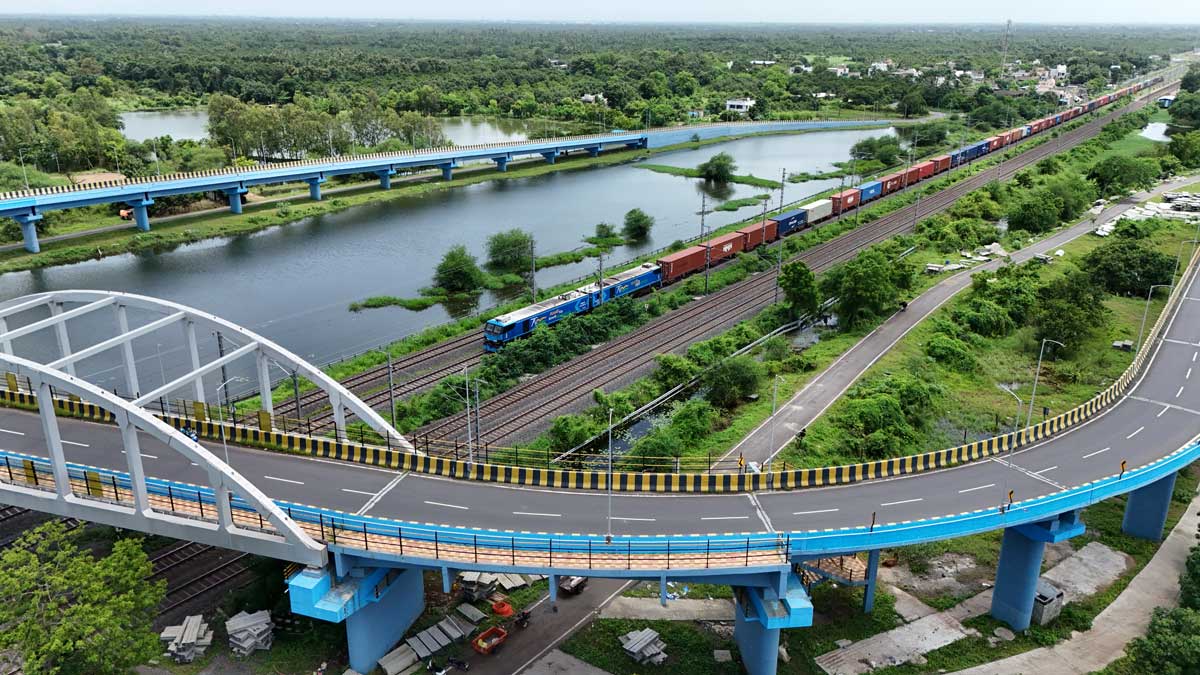
India must align businesses to approach logistics collaboratively, rather than planning movement in isolation, writes Samarnath Jha.
Every increase in diesel prices in India triggers the same discussion across boardrooms and transport yards: How much additional cost will the supply chain have to absorb? And what is the solution to these inflationary pressures?
With the country witnessing a nearly ₹7.5 increase in fuel prices, spread over four instalments in May, and with road transport still carrying the bulk of India’s freight, fuel costs continue to influence everything from transportation budgets to delivery economics. Supply chains must respond swiftly through concerted, collaborative initiatives, especially when inflation spirals.
As India moves closer to reducing logistics costs from 13-14 per cent of GDP to approximately 8 per cent, businesses should align to approach logistics more collaboratively, rather than planning movement in isolation. Such collaborations already exist in foreign trade, particularly with less-than-container-load (LCL) cargo. In interstate trade, it is less than truckload (LTL). However, similar setups can be utilised in last-mile deliveries as well, by leveraging technology, which can realign trades and improve efficiencies.
We can learn from how freight moves in many developed logistics markets. Countries such as Germany, the Netherlands and China have demonstrated this over many years. Shared movement planning and stronger coordination between stakeholders already play a major role in improving freight efficiency. Their logistics efficiency comes from the ability to use multiple transport modes as a single system. The opportunity in India is similar. The next gains in efficiency will come from utilising existing capacity more intelligently through better coordination, visibility and multimodal planning.
India has the right foundation required for a successfully operational multimodal logistics ecosystem. Freight corridors and strategic ports are the new frontiers that will fast-track this development. Vadhavan in Maharashtra—a strategic freight corridor—is being developed at an investment of over ₹760 billion. Vizhinjam, Kerala, is a port where Phase 1 is already operational, and further expansion is currently underway at an investment of over ₹97 billion. These new developments are beginning to create alternatives for long-haul cargo movement and expand India’s ability to handle larger trade volumes to strengthen our export competitiveness. Improving coordination across infrastructure planning, for initiatives such as PM Gati Shakti and the National Logistics Policy, is helping bring greater alignment between roads, railways, ports, waterways and logistics infrastructure.
An importer should be able to optimise the go-to-market strategy by leveraging tech and trade insights with a mix of immediate removal or custom warehousing. The mode of transportation should be at the disposal of the importer. Similarly, a manufacturer should be able to move cargo seamlessly from factory to rail terminal, from rail to port and onward to domestic or global markets with minimal delays, handoffs and cost leakages. Having such flexibility can add significantly to our GDP, since there is a vast difference in the per tonne per km (PTPK) cost for rail logistics (₹1.96), which is almost half of road logistics (₹3.78). Technology will play an important role in enabling visibility and coordination, but it delivers the greatest value when the underlying network itself is connected.
India has already done the hard part by creating significant logistics capacity. The next phase in this journey will be defined by how effectively existing infrastructure works together, along with the addition of new infrastructure.
ABOUT THE AUTHOR:

Samarnath Jha, CEO, Accex Supply Chain Solutions, brings over two decades of expertise in commercial strategy, planning, and M&A, with deep domain knowledge across manufacturing, supply chain, and freight services.