

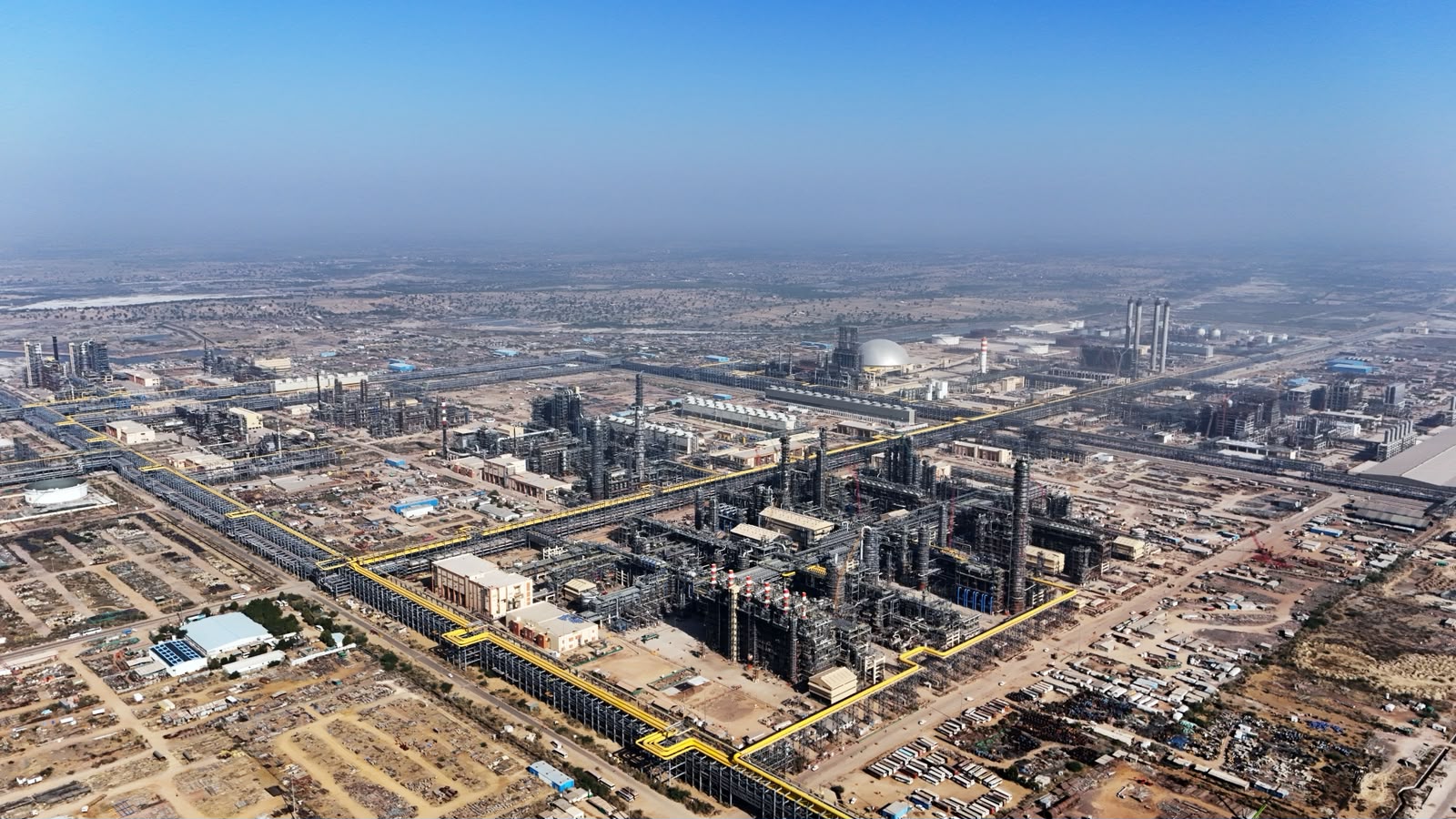
Against widespread forecasts of refinery closures, the launch of the HPCL facility emerges as a rare new‑build, large‑scale addition to global refining capacity.
Prime Minister Narendra Modi will dedicate the HPCL Rajasthan Refinery, India’s first greenfield integrated refinery‑cum‑petrochemical complex, to the nation in Rajasthan’s Balotra district. The commissioning of this landmark project marks a major achievement in India’s energy and petrochemical sector.
Developed as a joint venture between Hindustan Petroleum Corp. Ltd (HPCL) and the Government of Rajasthan, the 9 million metric tonnes per annum (MMTPA) refinery‑cum‑petrochemical complex has been established with an investment of over ₹794.5 billion. The facility is among several development projects worth around ₹1.06 trillion to be launched in Balotra, spanning petrochemicals, urban transport, railways, roads, renewable energy, and power transmission.
The state‑of‑the‑art complex integrates refining and petrochemical production, with a capacity of 2.4 MMTPA. It features a high Nelson Complexity Index of 17.0 and petrochemical yields exceeding 26 per cent, aligning with global benchmarks for efficiency and sustainability.
Global Context
The timing of the refinery’s launch is significant against the backdrop of global refining trends. No major greenfield refinery has been built in the US since Marathon’s Garyville plant in 1976, nearly half a century ago. In Europe, the International Energy Agency projects up to 1-1.5 million barrels per day of refining capacity at risk of closure by 2030. Global consultancy Wood Mackenzie identifies 101 refineries worldwide as vulnerable to closure by 2035, with Europe facing the steepest challenges.
In China, Shandong province — the hub of small independent ‘teapot’ refiners — is undergoing consolidation, with up to 500,000 barrels per day of capacity shut down amid tax and margin pressures.
Against this backdrop, the HPCL Rajasthan Refinery stands out as a rare new‑build, world‑scale addition to global refining capacity. It reinforces India’s position as a bright spot in global refining investment and underlines the country’s growing role in energy security and petrochemical production.
As the world’s third‑largest oil consumer, India’s refining capacity is set to be boosted further over the next couple of years. Addressing mediapersons ahead of the launch on Thursday, Union Minister for Petroleum and Natural Gas, Hardeep Singh Puri, said, “Our capital expenditure under this ministry and its public sector units includes several projects, such as refineries, which are already at an advanced stage. Over the next six months to two years, these will be implemented. Taken collectively, they will raise our refining capacity to about 300 MMTPA.”
World‑Scale Infrastructure
The infrastructure scale of the project is equally notable. It includes an 800 km cross‑country crude and product pipeline network connecting Mundra, Palanpur, Mangla, and Nachna, along with a dedicated crude oil terminal, jetty, and multiple raw water reservoirs to secure feedstock and water supply in the Thar desert.
The refinery has been designed with strong environmental safeguards. It operates on a zero liquid effluent discharge principle, ensuring no liquid waste leaves the plant boundary. Greenbelt initiatives have already seen the plantation of 125,000 saplings, with another 100,000 planned this year, alongside the development of a buffer zone. Solar plants are also being installed through HPCL’s 100 per cent green energy subsidiary, HPCL Renewable & Green Energy Ltd.
The product basket is fully compliant with the stringent Bharat Stage (BS)‑VI emission norms. Annual production capacity includes 995 kilo tonnes per annum (KTPA) of petrol and 4,035 KTPA of diesel. The diversified petrochemical portfolio includes polypropylene, polyethylene, butadiene, benzene, and toluene, reducing the country’s dependence on petrochemical imports and strengthening domestic industrial capacity.
– Manish Pant