With Vibrant Gujarat scheduled next year, the government is going all guns blazing to make this summit one of the mega events of the country.


Tag: MRTS
Post
Post

The Maha Metro Dream
In India, the urban rail network has grown significantly over the past 10-12 years, from about 90 km in 2006 to 444 km as we speak.
Post

India’s Metro Trail
The total length of operational metro projects in India presently stands at about 440 km and is growing. Cities like Bengaluru, Chennai, Gurugram, Kochi, Kolkata, Mumbai, Hyderabad, Jaipur, Lucknow and the Delhi National Capital Region (NCR) where they are already operational, are simultaneously adding on to their existing route networks.
Post

ENFORCEMENT OF CONTRACTS Mitigating the Uncertainty
There is a silver lining here: For the past two years, the Modi government has been adopting a broad strategy to substantially improve India's dismal WB ranking for ease of doing business. Concerted efforts have been made to remove serious bottlenecks that exist in the numerous business laws and a "holistic approach"taken.
Post

Urban Growth Corridors
India is one of the fastest growing and most populated economies in the world. By 2030, the urban areas would contribute 75 per cent of India's GDP and house 590 million people, about 40 per cent of the population.
Post

Mumbai Metro starts structural health monitoring
Aging, deterioration and extreme events like earthquakes and hurricanes can take a toll on roads, bridges and other structures.
With damage and defects often invisible, and to alert the authorities to potential problems and even impending catastrophic failure, the Mumbai Metro One has commissioned the world´s first real-time advanced Structural Health Monitoring System (SHMS) for Asia´s tallest cable stay bridge across the Western Express Highway (WEH)
Post

Metro systems viable for large cities
Let me clarify that the term ´Smart City´ does not denote scale. We can have small Smart Cities and large Smart Cities, both successful. The Mass Rapid Transport System or MRTS is really meant for large cities which have the population and economic density to sustain such expensive infrastructure
Post

METRONOMICS
The experience left the planners wiser. And this was evident in the 65 kilometres of the first phase of the ambitious Delhi Metro Project getting completed a full two years nine months ahead of schedule in 2005, in a period of a little over eight years.
Post

Empowering the Cities
Bringing safety, enhanced performance and lowered life-cycle cost to metros is the modern signalling technology called communication-based train control (CBTC). The methodology and technology have been perfected by companies like Thales.
Post
FDI Ultimate Game Changer
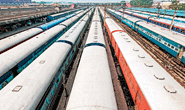
Though investment in infrastructure is expected to touch $1,025 billion in the Twelfth Five-Year Plan (2012-17), many hurdles are choking investment inflows despite the government´s overdrive to attract funds. The government´s recent decision to open up the railway sector to Foreign Direct Investment (FDI)