


With its strong multiplier effect on GDP, the Union Budget 2026-27 prioritises infrastructure by proposing to expand digital networks, advance the energy transition, strengthen the urban infrastructure index, and accelerate transport and logistics development, notes Rajashree Murkute.
Even as it focuses on job creation, micro, small and medium enterprises (MSMEs), and services, the Union Budget 2026-27 places special emphasis on infrastructure development. With its significant multiplier effect on GDP, the sector has remained a consistent priority across successive budget cycles. Key proposals include expanding digital infrastructure, advancing energy transition initiatives, strengthening the urban infrastructure index, and further developing transport and logistics networks. For starters, capital expenditure has been raised by 9 per cent to `12.20 trillion, with a substantial outlay of `5.71 trillion earmarked for railways and roads.
Railway capex has been increased by 10 per cent to Rs.2.77 trillion, with priority given to constructing new railway lines and doubling existing ones, developing seven high-speed rail corridors connecting major cities, and establishing new Dedicated Freight Corridors (DFCs) from Dhankuni in the East to Surat in the West. This is aimed at enhancing freight and passenger mobility through lower costs, higher efficiency, and improved safety. It will also facilitate faster and less expensive movement of coal cargo from mineral-rich eastern states to the rest of the country. These initiatives support a medium-term shift from road-to-rail and coastal transport, improving logistics efficiency, reducing carbon emissions, and lowering overall logistics costs. The development of high-speed rail corridors between major economic centres will shorten travel times, strengthen logistics performance, and promote regional growth. Collectively, these measures are expected to drive balanced economic development and help address demand-supply disparities.
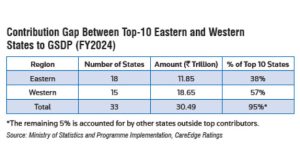
As shown in the accompanying
table, the contribution gap between the top ten eastern and western Indian states to overall gross state domestic product (GSDP) in FY2024 is nearly 20 per cent. Bridging this disparity is critical to addressing regional imbalances and ensuring more balanced economic development.
Connectivity capex
Proposed capex outlay for the roads sector has increased by 8 per cent to `2.94 trillion. While central government project awards have been subdued this fiscal, states have marginally improved their awarding activity, reinforcing the need for higher budgetary support. The sector’s share in the overall order books of major construction players has declined from approximately 75 per cent in FY2023 to 64 per cent in FY2025, affecting labour deployment levels. Nonetheless, steady asset monetisation by the apex highway development agency, the National Highways Authority of India (NHAI), and the enhanced budget allocation are expected to support a recovery in project awards and construction activity after a slow FY2026.
Over the next five years, 20 new waterways will be operationalised, accompanied by a coastal cargo promotion scheme aimed at increasing the share of inland waterways and coastal shipping from 6 per cent to 12 per cent by 2047. Leveraging India’s 11,098.81 km coastline, the planned expansion of waterways and coastal cargo movement is expected to materially strengthen logistics efficiency.
The country’s logistics performance is already showing notable improvement. The World Bank’s 2023 Logistics Performance Index further highlights ongoing progress in India’s trade logistics capabilities, driven by improvements in infrastructure, shipment tracking, and multimodal connectivity. Together, these developments illustrate a broader strengthening of India’s logistics ecosystem, with the expansion of waterways poised to enhance modal balance, reduce transport costs, and improve overall supply chain competitiveness.
Risk guarantee fund
Thus far, lending appetite for infrastructure has been mixed, with traditional banks primarily supporting construction phase financing, while pension funds, mutual funds, and insurance companies have focused on operational project assets. Over the past year, the Reserve Bank of India (RBI) has actively sought to strengthen project financing by introducing several measures, including the Partial Credit Enhancement Scheme, liquidity boosting rate cuts, and updated project finance guidelines. Collectively, these initiatives are expected to improve the overall environment for infrastructure financing and benefit stakeholders across the sector.
Against this backdrop, the launch of a new infrastructure risk guarantee fund is expected to aid in financing infrastructure projects with moderate to low credit profiles. While the details of the fund and underlying guidelines are awaited, the government’s intent to augment resources for funding new infrastructure projects is welcome.
Digital economy push
One of the most significant budget announcements relates to strengthening India’s digital infrastructure through a 20-year tax holiday until 2047 for foreign cloud service providers operating via Indian data centres. This policy aligns with the post-pandemic acceleration toward digital platforms,
rising AI-driven demand, and the sector’s recent designation as ‘infrastructure’, all of which have already triggered a sharp increase in investments.
Pre-budget estimates indicate a planned data centre capital outlay of approximately `600 billion through FY2028. The new tax incentive is expected to further accelerate data centre investments, enhance India’s competitiveness as a global data and AI hub, and catalyse additional real estate development as developers respond to growing demand for purpose-built data centre facilities. Meanwhile, the enhancement of the safe harbour threshold improves tax certainty, supports expansion by large IT firms and steady office space demand over the medium term.
Urban infrastructure drive
India’s urban population has risen significantly—from about 28 per cent in 2004 to 36 per cent in 2024—and is projected to reach 40 per cent by 2036. Rapid urbanisation continues to strain existing infrastructure, necessitating substantial capital investment by municipal corporations to bridge widening service gaps. As per CareEdge Ratings, municipal bond (munis) issuances in FY2026 are expected to touch `20 billion, a remarkable increase compared with the cumulative `30 billion raised over the seven years ending 2025, reinforcing improving market participation and financing prospects for urban development.
Two key announcements in the urban infrastructure segment include a `1 billion subsidy for single muni issuances of `10 billion and above, and the continuation of incentives under the Atal Mission for Rejuvenation and Urban Transformation (AMRUT), alongside a `50 billion allocation for City Economic Regions (CER) over five years. These measures are expected to broaden financing access and accelerate the growth trajectory of Tier-2 and Tier-3 cities, drawing greater private investment. The munis subsidy, in particular, should encourage larger issuances by urban local bodies (ULBs), deepen investor participation, and strengthen secondary market activity. Until now, the limited scale of munis offerings has led to illiquidity, making them unattractive to mutual funds, insurance companies, and pension funds.
Repeat issuances from large ULBs are likely to bridge this gap, making the budget proposal a significant positive for urban infrastructure development. At the same time, ULBs must focus on capability building, institutionalising robust management information systems (MIS) frameworks, and strengthening governance practices. Equally important is ensuring that the urban capital expenditure for which funds are being raised is deployed effectively to deliver the intended results. Acceptance of the 16th Finance Commission’s recommendation, along with the Centre’s `1.4 trillion allocation to states in FY2027 and retention of vertical devolution at 41 per cent, provides a major fillip to state-level capital investment.
Sectoral infrastructure boost
The budget also announced measures to strengthen shipping and aviation infrastructure. Plans include developing ship-repair ecosystems at Varanasi and Patna to support inland waterways, and promoting indigenous manufacturing of seaplanes under a dedicated viability gap funding (VGF) scheme. These initiatives are expected to reduce dependence on imported platforms, lower lifecycle costs for operators, and improve the viability of regional connectivity projects. The budget introduces several measures to support the expansion of renewable energy manufacturing, including extending Basic Customs Duty (BCD) exemptions for capital goods used in producing lithium-ion battery cells, battery energy storage systems, solar glass, and equipment for nuclear power projects through FY2035. These initiatives are designed to accelerate capacity creation and meet rising power demand across railways, urban infrastructure, MSMEs, data centres,
and industrial corridors. They are also expected to drive transmission and distribution investments and strengthen demand visibility for generation assets.
Additionally, the government has allocated `200 billion over five years for the adoption of carbon capture, utilisation, and storage (CCUS) technologies across sectors such as power, steel, cement, refineries, and chemicals. This commitment enhances long-term regulatory clarity for thermal power and improves its environmental, social and governance
(ESG) profile, reaffirming the continued importance of thermal generation in India’s energy mix. A long-term agenda targeting carbon-emitting industries, this step ensures a perfect balance between adequate non-intermittent power generation and meeting the reduced pollution threshold.
Monetisation push in the form of proposed recycling of real estate assets of Central Public Sector Enterprises (CPSEs) through dedicated real estate investment trusts (REITs) is expected to support their portfolio expansion and improve asset diversification. On the surface, this is a long-awaited announcement for monetising investments in prominent CPSEs which hold large real estate properties at very low book value. However, the valuation, rental terms, and transfer of legal rights must be clearly defined to attract REIT investors, particularly global participants.
Vision 2047 agenda
The budget’s core message is to position infrastructure as the growth propeller for achieving the Viksit Bharat 2047 vision, while sustaining public-private partnership (PPP) investments across sub-sectors, reducing tax uncertainty for global investors, and strengthening logistics efficiency. An important priority is to introduce policy frameworks that restrict profit repatriation by global investors in REITs and infrastructure investment trusts (InvITs), and encourage reinvestment of a share of these earnings within the country.
Simultaneously, the retail participation in the infrastructure growth story should also be encouraged. While all of the above is a continual process, the momentum of investments and collaboration between the Centre and States must be neither diluted nor moderated. Restricting steep variations in project awards, preventing contract reneging by state governments, and curbing prolonged arbitral and dispute-resolution processes are essential precursors to the success of infrastructure-led growth, alongside a favourable geopolitical environment.
About the author:
Rajashree Murkute, Senior Director for Large Corporate & Infrastructure Ratings, CareEdge Ratings
Infrastructure Priorities
• Rs 12.20 trillion capex represents a 9% increase, with Rs.5.71 trillion directed to railways and roads.
• Railway expansion will see Rs.2.77 trillion invested in new lines, track doubling, seven high-speed corridors, and fresh freight routes.
• Roads boost comes with Rs.2.94 trillion to revive project awards and construction activity.
• Digital infrastructure push offers a 20-year tax holiday for foreign cloud providers, spurring massive investments in data centres.
• Urban financing reforms include subsidies for large municipal bonds, Rs.50 billion for
City Economic Regions, and continued AMRUT incentives.
Towards Viksit Bharat 2047
• Balanced regional growth aims to bridge the 20% GSDP gap between 10 leading eastern and western states.
• Modal shift in logistics targets doubling the share of waterways and coastal shipping by 2047.
• Energy transition drive extends duty exemptions for renewables and allocates Rs.200 billion for carbon capture.
• Asset monetisation will recycle CPSE real estate through REITs to diversify portfolios, but mechanics remain unclear.
• Investment momentum necessitates stronger PPPs, greater retail participation, and centre–state collaboration.